
Last updated July 12, 2026
Air Duct Cleaning Permits, Codes & Inspections in CA: What You Need to Know
Here’s the detail that surprises most Woodland Hills homeowners: in the vast majority of cases, routine air duct cleaning does not require a permit in California — yet that single misconception causes people to either skip professional service entirely (fearing red tape) or hand money to contractors who invent permit fees that don’t exist. After 18 years working inside duct systems across the San Fernando Valley, Scott Hill has watched both scenarios play out more times than he can count. This guide — along with our The Complete Guide to Air Duct Cleaning in Woodland Hills — will walk you through exactly when California codes, permits, and inspections apply to duct work, when they don’t, and what any homeowner in Woodland Hills needs to know before scheduling service.
Quick Answer
Routine air duct cleaning in California does not require a permit. Permits are only triggered when physical modifications are made to the duct system itself — such as replacing, extending, or repairing ductwork — under California Mechanical Code (CMC) Title 24. A standard cleaning by a qualified technician using negative-pressure equipment falls outside the permit threshold, though any repair or sealing work beyond minor maintenance may require a licensed contractor and, in some jurisdictions, a permit pulled through your local building department.
Table of Contents
- Does Air Duct Cleaning Require a Permit in California?
- California Mechanical Code (CMC) and What It Covers
- When Permits Are Actually Required for Duct Work
- Inspections: What They Cover and When They Happen
- Woodland Hills-Specific Context: Climate, Code, and What We See
- Licensed Contractor vs. Cleaning Specialist: Understanding the Difference
- NADCA Standards and Industry Guidelines in California
- Common Mistakes to Avoid
- When to Call a Professional
- Frequently Asked Questions
- The Bottom Line
Does Air Duct Cleaning Require a Permit in California?
The short answer is no — and understanding why not helps you make smarter decisions about who you hire and what questions to ask. California’s building and mechanical codes regulate construction, installation, modification, and replacement of HVAC components. They do not regulate the act of cleaning a system that is already installed and functioning. Cleaning is a maintenance activity, not a construction activity, and that distinction is what places routine duct cleaning outside the permit framework.
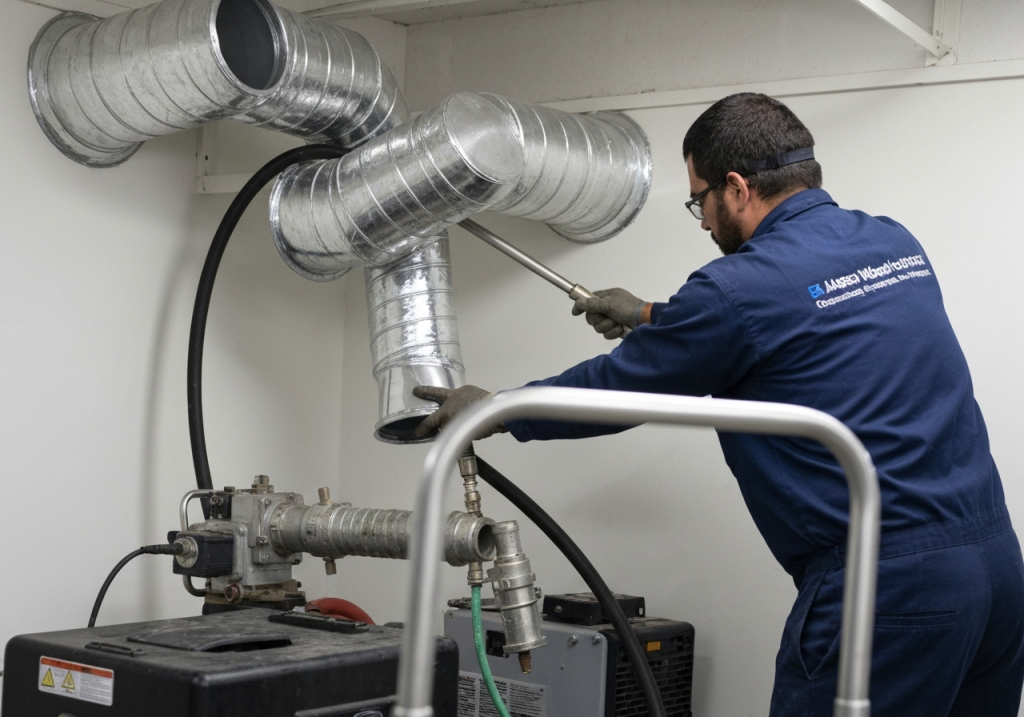
That said, “routine cleaning” has a specific meaning here. If a technician shows up, attaches a negative-pressure vacuum system — such as the truck-mounted units we use with Nikro and Rotobrush equipment — and agitates and extracts debris from your existing ducts without cutting new access panels into drywall, modifying register locations, or replacing duct sections, no permit is involved. The moment work shifts from cleaning to modification, a different set of rules kicks in.
Red flag to watch for: any company quoting you a “permit fee” for a standard duct cleaning is either confused about the code or adding a fabricated line item. If a contractor tells you a routine residential cleaning requires a permit in Los Angeles County, ask them to cite the specific code section. In our 18 years of operating in Woodland Hills and across the Valley, we’ve never once pulled a permit for a standard residential cleaning job — because none is required.
California Mechanical Code (CMC) and What It Covers
The California Mechanical Code — officially part of Title 24 of the California Code of Regulations — is the document that governs HVAC systems in the state. It adopts the Uniform Mechanical Code (UMC) with California amendments, and it establishes standards for the design, installation, alteration, and repair of mechanical systems including heating, ventilation, and air conditioning.
Key sections relevant to ductwork include:
- CMC Chapter 6: Covers duct construction and installation, including materials, insulation requirements, and sealing standards. Any new duct installation or replacement of existing ductwork must meet these specifications.
- CMC Section 604: Addresses combustion air and ventilation ducts specifically, with requirements for clearances and fire-rated assemblies in certain conditions.
- CMC Chapter 5: Governs exhaust systems, which includes dryer vents — a separate but related service area where code compliance matters significantly.
- Title 24 Part 6 (Energy Code): When duct systems are replaced or substantially modified, California’s Energy Code requires duct sealing and testing to meet leakage thresholds. This is a compliance item — not just a cleaning consideration — and it does trigger inspections in many counties.
The CMC is updated on a roughly three-year cycle, following the California Building Standards Commission’s adoption schedule. The current edition in effect as of 2026 is the 2022 California Mechanical Code. Local jurisdictions — including the City of Los Angeles and unincorporated areas of Los Angeles County where parts of Woodland Hills fall — can adopt local amendments, but those amendments must be at least as stringent as the state code, not more lenient.
When Permits Are Actually Required for Duct Work
Understanding the permit trigger line is critical for any homeowner planning work beyond a standard cleaning. Here is a numbered breakdown of scenarios that do require permits in California:
- New duct installation: Installing ductwork in a room addition, new construction, or converting a non-conditioned space to conditioned space requires a mechanical permit and inspection.
- Duct replacement: Replacing more than a minor section of ductwork — particularly in Los Angeles County — typically requires a mechanical permit. “Minor repair” is generally interpreted as patching or sealing isolated sections, not wholesale replacement of trunk lines or branch runs.
- HVAC system replacement: When a full air handler or furnace is replaced and new ductwork connections are made, the HVAC contractor must pull a mechanical permit. This is one of the most common scenarios Woodland Hills homeowners encounter after an equipment upgrade.
- Duct system extensions: Adding supply or return runs to serve a new room or space requires a permit because it modifies the mechanical system’s designed capacity and airflow balance.
- Fire-rated assembly penetrations: Any duct passing through a fire-rated wall or floor assembly requires inspection to verify compliant fire dampers and materials are in place. This applies to multi-family buildings and attached garages in residential settings.
- Post-remediation duct rebuilds: If a home has undergone mold remediation and ductwork was removed and replaced as part of that process, the rebuilding phase requires a permit in most California jurisdictions.
For the City of Los Angeles specifically, mechanical permits are issued through the Los Angeles Department of Building and Safety (LADBS). Woodland Hills falls within LADBS jurisdiction for most permit matters, and their online portal — ePermits — allows contractors to pull mechanical permits electronically.
Inspections: What They Cover and When They Happen
When a mechanical permit is required, a corresponding inspection is typically required before work is closed up inside walls or ceilings. Here’s how that process works in practice:
- Permit issuance: The licensed contractor (C-20 HVAC license in California) applies for and receives a mechanical permit from the local building department before work begins.
- Rough inspection: Before ducts are concealed, an inspector verifies that the installed ductwork meets CMC requirements for materials, connections, insulation, and clearances.
- Duct leakage testing (when required by Title 24): For new HVAC systems or substantially altered duct systems, California’s Energy Code requires duct leakage testing. The system must demonstrate leakage below a specified threshold — typically 15% or less of system airflow under Title 24 Part 6 — before passing final inspection.
- Final inspection: Once all work is complete and visible, the inspector signs off on the permit card. This final sign-off is what you want documented for your home sale records.
Inspections are not conducted for standard cleaning services. There is no California inspection protocol that applies to a technician running a Rotobrush agitation system and a Nikro HEPA vacuum through your existing ductwork. If anyone is suggesting otherwise, that is not an accurate representation of how California building inspections work.
Woodland Hills-Specific Context: Climate, Code, and What We See
Woodland Hills sits in the western San Fernando Valley at elevations ranging from roughly 800 to over 1,500 feet in the hillside neighborhoods. That geography creates some very specific duct system conditions that don’t show up in generic guides written from a desk somewhere outside California.
First, the climate: Woodland Hills regularly records the highest temperatures in Los Angeles County during summer heat events — triple-digit days are not unusual in July and August, and the Santa Ana wind events each fall push airborne particulates through every gap in a duct system. In neighborhoods like Walnut Acres, Vic Fazio, and the hillside streets above Mulholland Drive, we consistently find duct systems caked with fine valley dust, dried leaves, and particulate from the periodic brush fire events that affect this area. That debris load is meaningfully heavier than what you’d find in a coastal community, and it’s why homes here genuinely benefit from more frequent cleaning intervals than the national average of every 3-5 years.
Second, construction era matters in Woodland Hills. A significant portion of homes here were built between the late 1950s and the 1980s — an era when flex duct was widely used and duct sealing standards were far looser than current Title 24 requirements. In our experience working on these homes, it’s common to find disconnected duct sections in attics, deteriorated duct board lining, and supply runs that have been partially crushed by insulation added later. Any of those conditions cross the line from cleaning territory into repair territory — which is when the permit and code questions above become relevant.
Third, if you’re in Woodland Hills and your home was built after 1990, there’s a reasonable chance your attic ductwork is encapsulated with insulation batts that compress the flex duct over time. We document these conditions during every inspection and walk homeowners through exactly what’s code-compliant cleaning versus what needs a licensed HVAC contractor to address under permit.
Licensed Contractor vs. Cleaning Specialist: Understanding the Difference
This is a distinction that matters in California and one that many homeowners don’t fully understand until they’ve already had a problem. California requires a C-20 (Warm-Air Heating, Ventilating and Air-Conditioning) contractor license for anyone who installs, replaces, or structurally modifies HVAC ductwork. That license is issued by the California Contractors State License Board (CSLB) and requires testing, experience verification, and bonding.
Air duct cleaning, however, is not a licensed trade category in California. There is no state license specifically for duct cleaning. What matters instead is:
- Demonstrated expertise and equipment quality: A specialist using professional-grade equipment — Rotobrush, Nikro, and Abatement Technologies tools, for example — produces fundamentally different results than a general handyman with a shop vacuum.
- Industry certification: NADCA (National Air Duct Cleaners Association) offers the Air Systems Cleaning Specialist (ASCS) certification. While not required by California law, it’s the most credible credential in the industry.
- Business licensing: At the local level, any service business operating in Woodland Hills needs a valid City of Los Angeles business license or, for unincorporated county areas, a Los Angeles County business license.
- When duct repair is needed: If cleaning reveals that sections of your ductwork need to be replaced or significantly altered, that portion of the work must be performed by or under the supervision of a C-20 licensed contractor — or a C-2 (Insulation and Acoustical) contractor for insulation-related duct work.
Scott Hill — owner and lead technician at Premier Air Duct Solutions — handles the cleaning and inspection side personally on every job. When our assessment reveals structural duct issues that cross into licensed contractor territory, we tell you plainly what we found, document it, and help you understand exactly what kind of contractor you need for that next step. That transparency is part of what 1,226 verified reviews at a 4.9-star average tend to reflect.
NADCA Standards and Industry Guidelines in California
While California doesn’t mandate a specific cleaning frequency or method by law, the industry standard most contractors and property managers reference is NADCA ACR (Assessment, Cleaning and Restoration of HVAC Systems), currently in its 2021 edition. This standard establishes:
- Cleaning methodology: Source removal — physically extracting contamination from the duct system rather than just disturbing it — is the only method NADCA recognizes as a complete cleaning. This requires placing the system under negative pressure with a HEPA-filtered vacuum while agitating debris with contact cleaning tools.
- Cleaning triggers: NADCA identifies visible mold growth inside hard surface ducts, vermin infestation, and substantial debris deposits that restrict airflow as primary triggers for cleaning. EPA guidance aligns with this framework.
- Dryer vents: While NADCA focuses on HVAC air duct systems, the NFPA 96 and NFPA 211 standards govern dryer duct cleaning and are particularly relevant in California, where the fire risk from clogged dryer vents is treated seriously by building departments and fire marshals.
- Documentation: NADCA ACR recommends photographic before-and-after documentation of duct conditions. At Premier Air Duct Solutions, this is standard practice — every job in Woodland Hills gets documented so homeowners have a record of what was found and what was addressed.
For homeowners who want to connect Air Duct Cleaning in Woodland Hills with broader HVAC health, the relationship between clean ducts and system efficiency is well-documented: a 2022 study by Lawrence Berkeley National Laboratory found that duct leakage and contamination contribute meaningfully to HVAC energy losses in California homes, particularly in climates like Woodland Hills where systems run hard for months at a stretch.
Common Mistakes to Avoid
- Assuming every duct job is permit-free: Routine cleaning is permit-free — but the moment your technician discovers a disconnected duct section and you decide to have it repaired the same day, you’ve moved into work that may require a licensed contractor and potentially a permit. Don’t let the convenience of “while we’re in there” lead to unpermitted mechanical work.
- Hiring a general handyman for duct modification in Woodland Hills: The San Fernando Valley has no shortage of unlicensed contractors willing to patch or reroute ductwork without a permit. Work done without proper permits can surface as a major problem during a home sale inspection — and LADBS has authority to require corrective work even years after the fact.
- Conflating cleaning with remediation: If a technician identifies active mold growth inside your duct system, that is an environmental remediation situation — not a standard cleaning. Remediation in California often involves different contractor classifications and may require a clearance test after the work. Abatement Technologies equipment is built for that level of work; a shop vac is not.
- Skipping dryer vent cleaning because “it’s just lint”: The Los Angeles Fire Department responds to structure fires caused by clogged dryer vents every year. NFPA 211 recommends annual cleaning for residential dryer vents, and in Woodland Hills — where many homes have long duct runs due to laundry room placement — the lint accumulation rate is often faster than homeowners expect. See our Dryer Vent Cleaning in Woodland Hills page for more on this.
- Accepting a “duct cleaning” that doesn’t use negative pressure: Any cleaning method that doesn’t place the system under negative pressure before agitating debris is just redistributing contamination through your home. If the company arriving at your Woodland Hills home doesn’t have a truck-mounted or high-capacity portable vacuum unit, walk away.
- Ignoring attic ductwork after a brush fire season: Woodland Hills sits at the edge of the Santa Monica Mountains Recreation Area. After the fall fire season, fine particulate ash and smoke infiltration can deposit inside duct systems even in homes that were never directly threatened. We see this pattern every year in neighborhoods along Valley Circle, Topanga Canyon Boulevard, and the hillside streets — and it’s a real air quality issue, not a sales pitch.
- Waiting for the HVAC system to fail before thinking about the ducts: In California, HVAC system replacements require permits and trigger Title 24 duct leakage testing. Getting your ducts professionally cleaned and inspected before a planned equipment upgrade can actually give you a clearer picture of what duct repairs (if any) to budget for, before you’re in the middle of a replacement project.
When to Call a Professional
Call a qualified air duct cleaning specialist — not a general HVAC company — when you’re dealing with any of the following situations in your Woodland Hills home; for help choosing one, see How to Hire a Air Duct Cleaning Contractor in Woodland Hills: A Step-by-Step Guide:
- Visible dust discharge from supply registers when the system starts up
- Persistent allergy or respiratory symptoms that worsen indoors
- Recent renovation work that generated drywall dust or debris
- A home you’ve moved into where duct cleaning history is unknown
- Post-fire-season air quality concerns, especially in hillside neighborhoods
- Musty odors from vents, which may indicate moisture infiltration
- A new HVAC system installation where duct condition was never assessed
For a full HVAC Cleaning in Woodland Hills assessment that covers both the air distribution system and the equipment itself, Premier Air Duct Solutions offers free estimates. Scott Hill — owner and lead technician — personally handles every job. Call (661) 732-1148 to schedule your estimate. There’s no automated phone tree and no dispatch to an anonymous crew — you’re talking to the people who will actually do the work.
Frequently Asked Questions
Does air duct cleaning require a permit in California?
No — routine air duct cleaning does not require a permit in California. Permits are only required when ductwork is physically installed, replaced, or modified. Cleaning an existing duct system is a maintenance activity and falls outside California’s permit requirements under the California Mechanical Code (Title 24).
Does Woodland Hills fall under City of Los Angeles or Los Angeles County building codes?
Most of Woodland Hills is within the City of Los Angeles, which means the Los Angeles Department of Building and Safety (LADBS) has jurisdiction. The City of Los Angeles adopts the California Mechanical Code with local amendments, and mechanical permits for ductwork replacement or modification are handled through the LADBS ePermits system. A small number of parcels on the western edge near Topanga fall within unincorporated LA County, which uses LA County’s Department of Regional Planning for permit jurisdiction — worth confirming before any permitted duct work.
What license does an air duct cleaning company need in California?
California does not have a specific state license category for air duct cleaning. However, any duct modification or replacement work must be performed by a C-20 licensed contractor. Cleaning-only companies should carry valid local business licenses and, ideally, NADCA certification. If a cleaning company also offers duct repair, ask to verify their C-20 license number through the CSLB website before authorizing that repair work.
How often should Woodland Hills homeowners clean their air ducts?
NADCA and EPA guidance generally points to a 3-5 year cleaning interval for average residential conditions, but Woodland Hills is not an average residential environment. The combination of extreme summer heat, heavy dust loads from the Valley floor, and annual fire-season particulate means we typically recommend every 2-3 years for homes in this area — and annually for homes where occupants have respiratory sensitivities or where pets are present. After any major renovation or brush fire event, don’t wait for the interval — schedule an assessment.
Does replacing my HVAC system in Woodland Hills require duct testing?
Yes, in most cases. California’s Title 24 Energy Code requires duct leakage testing when an HVAC system is replaced or when more than 40 linear feet of ductwork is replaced in existing homes. The test must show duct leakage below the threshold specified in the energy compliance documents — typically 15% of system airflow. This testing is performed by the HVAC contractor and verified during the final mechanical inspection. Having your ducts professionally cleaned and documented before a system replacement is a smart preparatory step that can reveal whether sealing work is needed ahead of that compliance test.
Is air duct sanitizing regulated in California?
Yes — chemical treatments applied inside HVAC duct systems are regulated by the EPA under the Federal Insecticide, Fungicide, and Rodenticide Act (FIFRA), and by California’s Department of Pesticide Regulation (CDPR). Only EPA-registered products may be applied inside duct systems. Reputable companies use products like those in the Honeywell and Aprilaire line that are specifically registered for HVAC air quality applications. If a company offers “duct sanitizing” and can’t name the specific EPA-registered product they’re using, that’s a compliance red flag — and potentially a health risk.
The Bottom Line
Routine air duct cleaning in California doesn’t require a permit — but the moment work shifts from cleaning to modification, replacement, or sealing beyond minor repairs, you’re in permit territory under the California Mechanical Code. In Woodland Hills specifically, the combination of older housing stock, intense summer heat, and fire-season air quality makes duct health a more pressing issue than in many other California communities. Know the line between cleaning (no permit) and mechanical work (permit required), verify that any contractor doing structural duct work carries a C-20 license, and insist on genuine source-removal cleaning methods. The Premier Air Duct Solutions Woodland Hills home is a good starting point if you want a specialist who keeps all of this straight so you don’t have to.
Key Takeaways:
- Cleaning = no permit required in California.
- Duct replacement, extension, or modification = mechanical permit required.
- HVAC system replacement triggers Title 24 duct leakage testing.
- No state license exists for cleaning; duct modification requires a C-20.
- Only EPA-registered products may legally be applied inside California duct systems.
- Woodland Hills homes face above-average dust and fire-season particulate loads — clean more frequently than national averages suggest.
Ready to get your system assessed by someone who actually knows Woodland Hills duct systems? Call (661) 732-1148 for a free estimate. Scott Hill — owner and lead technician — handles the job personally. No franchises, no entry-level crews, no guesswork.
Written by the team at Premier Air Duct Solutions Woodland Hills, serving Woodland Hills since 2008. For more guides & resources, visit our blog.