
Last updated July 12, 2026
Seasonal Air Duct Cleaning Care for Woodland Hills: Year-Round Homeowner’s Guide
Here’s the detail most Woodland Hills homeowners get completely wrong: the frequency recommendation on your air filter has almost nothing to do with how often your ducts actually need cleaning. Filters catch what’s already moving through the system — they don’t address what’s already settled inside your ductwork over years of operation. In a climate like Woodland Hills, where Santa Ana wind events push fine particulate matter through every unsealed gap in a home’s envelope, and where wildfire smoke seasons have grown longer and more intense, the inside of an average duct system accumulates contaminants far faster than that generic “every 3-5 years” guideline suggests. This guide walks you through what’s actually happening inside your ducts in each season, what warning signs to act on, and how to build a maintenance rhythm that matches where you live — not where the advice was written.
Quick Answer
Woodland Hills homeowners should schedule our Air Duct Cleaning services every 2 to 3 years as a baseline, with additional cleanings warranted after wildfire smoke events, Santa Ana wind seasons, major renovations, or if household members have allergies or respiratory conditions. The local combination of dry heat, high-particulate wind events, and an extended fire season compresses the standard national maintenance timeline and makes year-round duct awareness — not just a single annual checkup — the smarter approach.
Table of Contents
- Why Woodland Hills Climate Changes Everything About Duct Maintenance
- Spring: Clearing Out What Winter Left Behind
- Summer: Your HVAC System Is Working Overtime — and So Are Your Ducts
- Fall: Santa Ana Season and the Wildfire Smoke Factor
- Winter: The Quiet Season That’s Not as Quiet as You Think
- How Professional Air Duct Cleaning Actually Works
- What to Do Between Professional Cleanings
- Common Mistakes to Avoid
- When to Call a Professional
- Frequently Asked Questions
- The Bottom Line
Why Woodland Hills Climate Changes Everything About Duct Maintenance
National duct cleaning guidelines are written for a national average climate — moderate humidity, moderate pollen counts, and no meaningful wildfire exposure. Woodland Hills doesn’t fit that profile. Sitting at the western edge of the San Fernando Valley, the area experiences some of Southern California’s most extreme temperature swings, lowest relative humidity levels during fall and winter, and direct exposure to the wind corridors that funnel Santa Ana conditions down from the high desert.
That combination creates two specific duct problems that homeowners here deal with more than most:
- Dust loading from wind intrusion: When Santa Ana conditions drop indoor humidity below 20% and wind pressure differentials change, fine clay-based desert dust infiltrates duct systems through return air grilles, flex duct connection points, and any imperfectly sealed boot. We’ve opened systems in West Hills and Calabasas-adjacent neighborhoods along the 101 corridor and found dust accumulations that would be remarkable for a system twice the age.
- Smoke particulate from fire seasons: Ultrafine smoke particles — smaller than standard filters capture — settle into ductwork and on evaporator coil surfaces. Unlike ordinary dust, they carry volatile organic compounds that off-gas into living spaces long after a fire event ends.
Understanding the local environment is step one. The rest of this guide walks through each season with Woodland Hills conditions front of mind — not generic advice repackaged with a city name dropped in — and you can find more guides & resources on our site.
Spring: Clearing Out What Winter Left Behind
Spring is the right time for a baseline inspection in Woodland Hills for a simple reason: the rainy season has just ended, and if any moisture found its way into your duct system between November and March — through a cracked flex duct section, a condensation drain issue, or a roof event that affected your attic — you want to find it before you run the AC continuously for five months.
What a qualified spring inspection should include:
- Visual inspection of accessible ductwork in the attic. In most Woodland Hills homes built between 1965 and 1990, flex duct runs through unconditioned attic space. After a wet winter, check for visible sag, disconnected joints, or any signs of animal entry — roof rats are active in the foothills neighborhoods and will compromise duct insulation.
- Return air grille assessment. Pull the grilles and look at the first 12 inches of duct. If you see a gray-to-black fur coating, that’s a reliable signal the full system interior warrants attention.
- Filter housing inspection. Check whether the filter seat is fully sealed. A poorly seated filter in a return plenum is one of the fastest ways to load a duct system with debris that bypasses filtration entirely.
- Pollen season preparation. Woodland Hills tree pollen — particularly from the sycamores and liquid ambers in neighborhoods like Walnut Acres — peaks April through May. If you or a household member has allergies, having the system cleaned before peak pollen season, rather than after, meaningfully reduces the amount of pollen that circulates and deposits in the duct interior.
Spring pricing for duct cleaning in the Woodland Hills market typically runs $300–$550 for a standard single-story home, with larger or two-story properties ranging $450–$750 depending on system access complexity and the number of supply and return registers.
Summer: Your HVAC System Is Working Overtime — and So Are Your Ducts
Woodland Hills summers are legitimately punishing. Temperatures routinely exceed 100°F in July and August, and the HVAC system in a typical 2,000-square-foot home here may run 10 to 14 hours per day during a heat event. That volume of air movement accelerates whatever contamination is already inside your ducts and deposits it steadily on evaporator coil surfaces — which is where efficiency losses become real and measurable.
A partially restricted evaporator coil — one coated with a thin layer of dust and debris — can reduce system efficiency by 15 to 20 percent. In a Woodland Hills summer, that translates to meaningful increases on an already elevated electric bill. It also forces the compressor to work harder under conditions that already stress residential equipment to its design limits.
Summer-specific concerns to monitor:
- Condensation and microbial growth: When a high-efficiency AC system runs for extended periods, condensation on the evaporator coil is normal. If that coil surface has an organic debris layer — and cooling is repeatedly interrupted and resumed, as happens during power fluctuations — conditions for mold colonization on the coil and in the drain pan can develop quickly.
- Dryer vent performance: This one surprises homeowners, but summer is actually a high-risk season for dryer vent clogs. Longer daylight hours mean more laundry cycles, lint accumulates faster, and the hotter ambient air in attic-routed dryer vents reduces exhaust efficiency. A clogged dryer vent is a fire hazard regardless of season — Dryer Vent Cleaning in Woodland Hills is a service we handle as a standalone appointment, separate from duct cleaning, because it warrants dedicated attention.
- Post-renovation cleaning: Summer is peak renovation season. Drywall dust, insulation fiber, and construction debris that enters an active duct system during a remodel is some of the most damaging contamination we encounter — it compacts, holds moisture, and can clog registers within weeks.
Fall: Santa Ana Season and the Wildfire Smoke Factor
September through December is the highest-stakes period for indoor air quality in Woodland Hills. Santa Ana wind events bring low humidity (sometimes below 10%), high wind speeds, and a surge of fine particulate matter from the desert that permeates even well-sealed homes. Simultaneously, this is the period of greatest wildfire risk in the hills and canyons surrounding the San Fernando Valley.
During the 2019 Easy Fire and the 2018 Woolsey Fire, homes in Woodland Hills and the adjacent hill neighborhoods — including properties in Hidden Hills-adjacent areas and along Topanga Canyon Boulevard — reported persistent smoke odors indoors for weeks after the fires were contained. That odor is the result of smoke particles and volatile compounds embedded in ductwork, coil surfaces, and return plenum interiors. Standard filter changes don’t remove it.
After any significant regional smoke event, here’s what a proper remediation sequence looks like:
- Run the system on recirculate (not fresh air) until outdoor air quality returns to acceptable levels — typically AQI below 100.
- Change the air filter immediately after the smoke event, even if it was recently replaced.
- Schedule a professional duct cleaning that includes evaporator coil inspection and, if indicated, air quality sanitizing using an EPA-registered antimicrobial agent.
- Consider a whole-home air purification solution — we integrate Honeywell and Aprilaire whole-home systems that address ultrafine particles the standard filter media can’t capture.
Fall is also when we most consistently recommend scheduling HVAC Cleaning in Woodland Hills as a paired service alongside duct cleaning — the coil, blower wheel, and drain pan accumulate the season’s worst contamination and going into winter with a clean system matters for both efficiency and air quality.
Winter: The Quiet Season That’s Not as Quiet as You Think
Woodland Hills winters are mild by most standards, but they’re not a maintenance vacation for your duct system. December through February is when most homeowners shift from cooling to heating — and the first time the furnace fires up after months of dormancy is when the dust and debris that settled in heat exchanger cavities and lower duct runs gets pushed directly into living spaces.
If you notice a burning smell the first time you run heat each season, that’s oxidized dust on the heat exchanger and in the supply plenum. It’s usually not dangerous, but it’s a strong indicator that the system interior hasn’t been serviced recently.
Winter-specific maintenance priorities:
- Duct sealing assessment: Cold nights make duct leakage losses tangible. If certain rooms feel consistently cooler than others, or if your heating costs seem disproportionate to usage, leaking duct connections are a common cause in older Woodland Hills homes with original flex duct installations. Duct repair and sealing can often recover 20 to 30 percent of conditioned air that was previously being lost into unconditioned attic space.
- Rodent activity inspection: Winter drives small rodents to seek shelter in attic spaces — the same space where most of your ductwork runs. We regularly find compromised flex duct sections and debris-filled plenums in homes in the hillside neighborhoods above Mulholland Drive, particularly after a cold November.
- Holiday activity and indoor air quality: More time indoors, more cooking, candles, and guests means higher indoor particulate loading. It’s not a cleaning trigger on its own, but if you’re already due for service, winter is a reasonable time — demand is lower and scheduling is often easier than the spring-summer rush.
How Professional Air Duct Cleaning Actually Works
Understanding the process helps you evaluate any quote you receive. A legitimate professional cleaning is not a shop vacuum and a brush — and any service priced below $99 flat for a whole-home system is almost certainly a bait-and-switch lead-generation operation, not a real cleaning.
Here’s what a proper cleaning sequence looks like when Scott Hill — owner and lead technician at Premier Air Duct Solutions Woodland Hills home — is on the job:
- System assessment: Before any equipment goes into the duct system, the configuration is documented — supply versus return layout, register locations, approximate duct lengths, and system age. This determines which equipment configuration is appropriate.
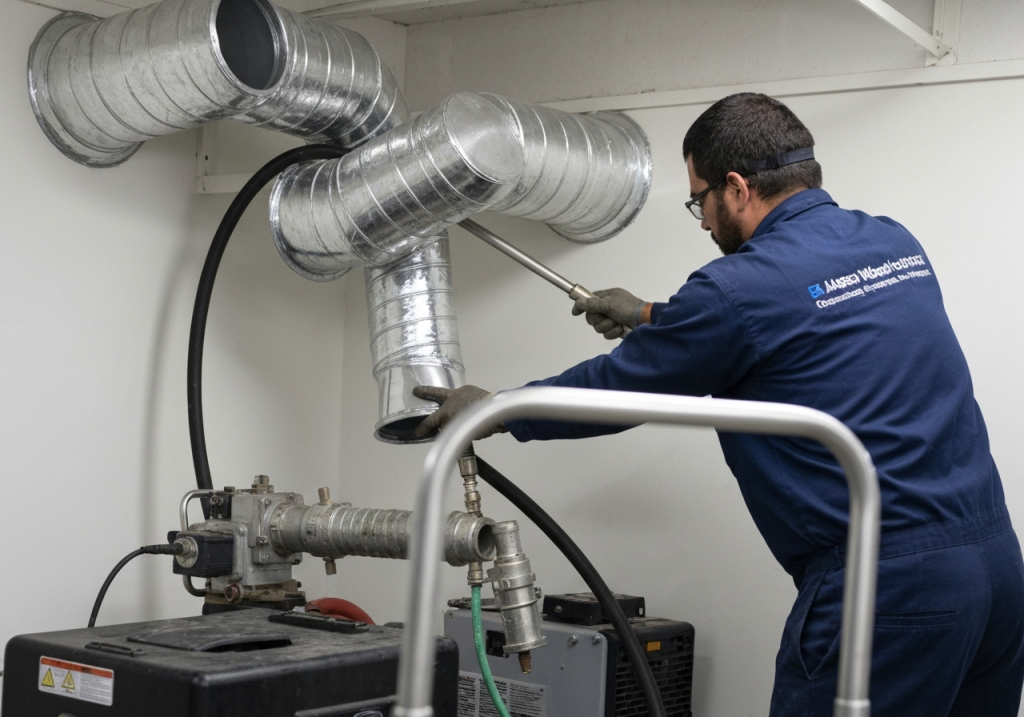
- Source removal with negative pressure: Professional-grade equipment from Nikro or Abatement Technologies creates negative air pressure inside the duct system while agitation tools — including Rotobrush rotary brush systems — dislodge adhered debris from duct walls. The debris is pulled toward the negative pressure source, not redistributed into the living space.
- Register-by-register cleaning: Each supply and return register is isolated, cleaned at the duct opening, and sealed until the main trunk is addressed. Cutting corners here — cleaning the trunk and skipping branches — is a common shortcut that leaves the majority of particulate loading untouched.
- Blower compartment and plenum cleaning: The blower wheel, blower compartment, and both supply and return plenums are cleaned as part of a complete service. If only the duct branches are cleaned without addressing the plenums, the system re-contaminates within weeks.
- Sanitizing (when indicated): In cases of confirmed microbial growth, post-fire smoke remediation, or systems with confirmed moisture history, an EPA-registered sanitizing agent — applied with Abatement Technologies fogger equipment — is used to address biological contamination that physical removal alone doesn’t resolve.
- Post-cleaning documentation: Before and after photos of the duct interior are standard practice. If a contractor doesn’t offer this, ask why.
What separates this from a franchise crew arriving with unfamiliar equipment: Scott Hill has 18 years focused exclusively on air duct and HVAC cleaning. That single-category experience — not general HVAC repair knowledge applied loosely to duct work — is what makes the difference between cleaning that lasts and cleaning that doesn’t.
What to Do Between Professional Cleanings
Professional cleaning is not a set-and-forget event. What you do between appointments — guided by our Air Duct Cleaning Maintenance Checklist for Woodland Hills Homeowners — has a direct effect on how quickly the system reloads with contamination — and therefore how long a proper cleaning stays effective.
Filter maintenance: In Woodland Hills, a MERV 8 filter is a reasonable baseline for a standard system. During Santa Ana season or after a regional smoke event, stepping up to a MERV 11 or MERV 13 temporarily captures more fine particulate — but check with your HVAC technician first, as very high-MERV filters can restrict airflow in systems not designed for the added resistance. Replace filters every 30–45 days during high-use seasons, not every 90 days as the packaging often suggests.
Grille and register cleaning: Dust collects at register faces and in the first few inches of duct behind each grille. Remove grilles quarterly and vacuum the visible duct section with a HEPA-filtered vacuum attachment. This is not a substitute for professional cleaning, but it meaningfully slows recontamination.
Attic access point inspection: If you’re comfortable accessing your attic safely, visually checking visible flex duct connections twice a year — once in spring, once in fall — for signs of disconnection, rodent damage, or compressed sections is worthwhile. A crushed flex duct section is both an airflow restriction and a debris accumulation point.
Indoor air quality monitoring: Inexpensive consumer-grade IAQ monitors (Honeywell and Aprilaire both produce models appropriate for residential use) can flag spikes in particulate levels that suggest the duct system or a specific room has a contamination issue worth investigating before the next scheduled cleaning.
The full picture on Air Duct Cleaning in Woodland Hills — including what’s included in a complete service visit — is worth reviewing before you schedule, so you know exactly what you’re comparing when evaluating contractors.
Common Mistakes to Avoid
- Hiring based on the lowest quote without understanding what it includes. In the Woodland Hills market, we’ve followed behind contractors who charged $79 for “whole-home duct cleaning” and left systems in worse condition than before — debris dislodged but not removed. A legitimate cleaning covering a typical 3-bedroom Woodland Hills home costs $300 minimum; anything substantially below that is a red flag worth investigating.
- Cleaning ducts without addressing the coil and blower wheel. Cleaning duct branches while leaving a contaminated evaporator coil and blower wheel in place is the equivalent of washing your plates while leaving the sink full of dirty water. The system recontaminates within weeks because the source of re-entrainment hasn’t been addressed.
- Skipping service after a wildfire smoke event. Many Woodland Hills homeowners assume that once outdoor air quality improves, the problem is resolved. Smoke particulate embedded in ductwork continues to off-gas and recirculate for months. Post-fire cleaning is not optional if you experienced meaningful smoke intrusion.
- Using the wrong filter MERV rating for the system. A MERV 16 filter in a system sized for MERV 8 doesn’t improve air quality — it starves the system of airflow, increases static pressure, and accelerates wear on the blower motor. Filter choice should be matched to the system, not just the particle the homeowner wants to capture.
- Ignoring dryer vent cleaning because “the dryer still works.” A partially clogged dryer vent dramatically increases drying time and heat buildup — it doesn’t fail catastrophically before becoming dangerous. In Woodland Hills homes where dryer vents route through long attic runs, annual cleaning is appropriate regardless of visible symptoms.
- Assuming new construction means clean ducts. Construction debris in new Woodland Hills builds — drywall dust, sawdust, and insulation fiber — enters duct systems during framing and finishing before filters are even installed. New-construction duct cleaning within the first year of occupancy is consistently one of the most impactful cleanings we perform.
- Treating duct cleaning as a one-time event. A duct system in a Woodland Hills home exposed to fire seasons, Santa Ana winds, and high summer AC demand will reload with contamination on a 2-3 year cycle under normal conditions, faster under adverse conditions. A single cleaning with no follow-up plan is not a long-term indoor air quality strategy.
When to Call a Professional
Some situations don’t wait for your scheduled maintenance window. Call a professional if you notice visible mold growth at or near any supply or return register, if you can smell mildew or smoke when the system runs, or if you discover evidence of rodent activity inside the ductwork — droppings near registers or audible movement in the ducts. Allergy or asthma symptoms that worsen consistently when the HVAC system is running — and improve when it’s off — are a reliable clinical signal that the air distribution system warrants inspection. After any significant construction or renovation project, professional cleaning is appropriate regardless of timing. The same applies after a regional wildfire event with documented smoke intrusion into your Woodland Hills home.
Premier Air Duct Solutions Woodland Hills offers free estimates in Woodland Hills — call (661) 732-1148 to schedule a no-obligation assessment. Scott Hill handles every estimate personally, so you’re talking to 18 years of specific expertise from the first conversation.
Frequently Asked Questions
How often should Woodland Hills homeowners get their air ducts cleaned?
Most Woodland Hills homes warrant professional duct cleaning every 2 to 3 years under normal conditions. Homes with pets, allergy sufferers, or significant wildfire smoke exposure should shorten that interval to every 18 to 24 months. Homes that experienced direct smoke infiltration during a regional fire event should schedule cleaning regardless of when the last service occurred — smoke particulate contamination doesn’t follow a maintenance calendar.
What does air duct cleaning cost in Woodland Hills?
Professional air duct cleaning in Woodland Hills typically runs $300–$550 for a standard single-story home with a standard number of registers, and $450–$750 for larger or two-story properties depending on system complexity and access. Any quote significantly below $200 for a whole-home service deserves close scrutiny — it’s worth asking specifically what the price includes: trunk cleaning only, or all branches, plenums, and blower compartment.
Is air duct cleaning worth it after wildfire smoke in the Woodland Hills area?
Yes — post-wildfire duct cleaning is one of the most justified uses of the service in Southern California. Ultrafine smoke particles and volatile organic compounds embed in duct liner, coil surfaces, and insulated duct walls. They continue to off-gas and recirculate through the living space for months after outdoor air quality recovers. Cleaning combined with air quality sanitizing — using an EPA-registered antimicrobial fogger — is the appropriate response after confirmed smoke intrusion.
Can I clean my own air ducts instead of hiring a professional?
DIY duct cleaning with a household vacuum and a dryer-vent brush addresses only the first few inches of accessible duct — the parts that matter least. The debris loading that affects air quality and system efficiency is in the main trunk lines, branch connections, blower wheel, and plenum surfaces. Reaching and dislodging that material requires negative-pressure source removal equipment — specifically, professional-grade tools like Rotobrush and Nikro systems — not consumer equipment. Attempting DIY cleaning without negative pressure can actually redistribute settled debris into living spaces.
How long does professional air duct cleaning take in a typical Woodland Hills home?
A proper whole-home duct cleaning in a standard Woodland Hills single-story home (3 bedrooms, 10–15 registers) takes 3 to 4 hours when performed correctly. Larger two-story homes or systems with extensive branch configurations can run 4 to 6 hours. Any contractor quoting a 45-minute or 1-hour whole-home cleaning is not performing a complete service — that timeline is physically insufficient for source removal at every register location.
Do Woodland Hills homes need any permits for duct cleaning or duct repair?
Routine air duct cleaning does not require a permit in Woodland Hills or the Los Angeles area. Duct repair and sealing work — particularly in homes subject to Title 24 energy code compliance requirements — may involve documentation if the work is part of a larger permitted renovation or HVAC replacement project. For standalone duct repair and sealing, no permit is required in most residential scenarios. If you have questions specific to your property, the Los Angeles Department of Building and Safety can confirm requirements based on your project scope.
The Bottom Line
Duct maintenance in Woodland Hills is not a once-a-decade task — it’s a year-round awareness practice shaped by local conditions that most national guidelines don’t account for. Spring moisture checks, summer efficiency management, fall smoke remediation, and winter heating-season preparation each represent a distinct window where attention to your duct system pays direct dividends in air quality and system performance. The 2-to-3-year professional cleaning interval is a starting point, not a ceiling — local wildfire seasons, Santa Ana events, and renovation activity all justify accelerating that schedule. Pair professional service with between-cleaning maintenance habits, and your system performs better and stays cleaner, longer.
Key Takeaways:
- Clean every 2–3 years baseline; shorten to 18–24 months after smoke events, renovations, or with allergy sufferers in the home.
- Fall is the highest-stakes season in Woodland Hills — Santa Ana winds and wildfire smoke are the primary local duct contaminants.
- Coil and blower cleaning must accompany duct branch cleaning — partial cleaning leads to fast recontamination.
- MERV 8–11 filters, changed every 30–45 days during high-use seasons, are appropriate for most Woodland Hills systems.
- Post-construction cleaning in new Woodland Hills builds is consistently one of the highest-impact single services available.
- Professional-grade source-removal equipment — not consumer vacuums — is required for a cleaning that actually lasts.
Ready to put a specific plan together for your home? Call (661) 732-1148 and speak directly with Scott Hill — owner and lead technician at Premier Air Duct Solutions Woodland Hills. He’ll assess your system, give you a straight answer on what it needs, and provide a free estimate with no pressure attached. With 1,226 verified reviews averaging 4.9 stars, the track record speaks before we say another word.
Written by the team at Premier Air Duct Solutions Woodland Hills, serving Woodland Hills since 2008.