
Quick Summary
While commercial vs residential duct cleaning differs significantly in system scale, equipment, and logistics, Premier Air Duct Solutions Woodland Hills serves as the ideal local partner by offering specialized divisions tailored to the distinct structural and operational demands of each property type. Residential jobs typically utilize portable HEPA vacuums for straightforward setups, whereas complex commercial systems require industrial negative air machines, zoned isolation, and custom on-site walkthroughs. To ensure optimal HVAC performance and safety, property owners should contact Premier Air Duct Solutions Woodland Hills for a free, no-obligation estimate and professional consultation.
Commercial and Residential Duct Cleaning Differ Mainly in Scale, Complexity, Equipment, and Logistics
If you manage a commercial property in Woodland Hills or are trying to reduce the dust settling on your living room furniture in Calabasas, you might wonder how duct cleaning actually works for different properties, which is why Premier Air Duct Solutions Woodland Hills explains these differences to local clients. While the main goal is to clear out accumulated debris, the processes for homes and commercial buildings differ mainly in scale, complexity, equipment, and logistics.[4]
Commercial Vs Residential Duct Cleaning: Key Differences and Quick Summary
The main differences between commercial and residential duct cleaning come down to system scale, layout complexity, and the type of filtration used. Home systems are typically straightforward, single-family setups. Commercial properties, on the other hand, use complex networks with multi-zone air handlers, fire dampers, and extensive main trunks that require systematically zoned isolation during cleaning.[3] See also Air Duct Cleaning in Woodland Hills: Breathe Easier, Pay Less.
The “Filtration Efficiency Paradox” Marketing Concept
Some industry marketing materials refer to a concept known as the “Filtration Efficiency Paradox” to describe differences in dust accumulation. This concept suggests that commercial HVAC systems, which often use higher-efficiency filters and tighter seals, may prevent bypass dust better than some residential setups. In contrast, residential systems might allow fine dust, pet dander, or pollen to bypass filters through small gaps. However, this concept is primarily a marketing term rather than a universally accepted scientific principle.[5]
Quick Comparison Summary
| Feature | Residential Ducts | Commercial Ducts | Industrial Ducts |
|---|---|---|---|
| System Scale | Small, single-family homes (usually 1 to 2 zones) | Medium to large buildings (multi-zone, complex layouts) | Massive manufacturing or processing facilities |
| Primary Equipment | High-power portable HEPA vacuums and rotary brushes | Truck-mounted vacuums or heavy-duty negative air units | Specialized explosion-proof or chemical-resistant collectors |
| Primary Pollutants | Household dust, pet dander, lint, and pollen | Commercial dust, paper fibers, and office pollutants | Chemical residues, metal shavings, or process dusts |
What the Science Says About Duct Cleaning
When researching this service, it is important to look at objective scientific data. The U.S. Environmental Protection Agency (EPA) states that duct cleaning has not been shown to prevent health problems. Studies indicate that particle levels in homes do not conclusively rise due to dirty air ducts alone. For example, a nine-home field study conducted by the EPA and Acurex Environmental Corporation found no clear evidence that cleaning residential ducts improved overall indoor air quality.
Furthermore, reviews of scientific literature indicate that evidence for improved airflow, energy use, or health outcomes from duct cleaning is insufficient. Because of this, the EPA does not recommend routine duct cleaning as a preventative measure, suggesting instead that it be considered on an as-needed basis (such as after home remodeling, if there is visible mold growth, or in the event of a rodent infestation).
To protect yourself from dishonest sales tactics, the EPA suggests getting written estimates from at least three different service providers and being skeptical of companies that claim routine cleaning is necessary for everyone. Premier Air Duct Solutions Woodland Hills aligns with these standards, providing honest, transparent assessments to residents in Encino, Topanga, and Agoura without pushy upselling.
Do Commercial and Residential Duct Cleaning Use the Same Equipment?
Need commercial vs residential duct cleaning?
We’re available now — call for a fast, free estimate.
No, they do not. The machinery used for a home differs from what is required to clean a commercial office building or retail space. Using residential tools in a commercial space may be ineffective, while commercial-scale machinery, like that utilized by Premier Air Duct Solutions Woodland Hills, is designed for larger systems.
Commercial Equipment vs. Residential Tools
Commercial duct cleaning relies on powerful negative air machines. This is because commercial ductwork has a larger volume of air to move. Technicians typically seal off sections of the building and clean them zone by zone to maintain static pressure.
Residential cleaning, on the other hand, typically uses portable HEPA-filtered vacuum systems or truck-mounted vacuum lines. These are designed to navigate tight attic spaces, closets, and crawlspaces.
| Equipment Feature | Residential Systems | Commercial Systems |
|---|---|---|
| Vacuum Power | Portable HEPA units | Industrial negative air machines |
| Agitation Tools | Flexible whips and soft-bristled brushes | Pneumatic whips, heavy rotating brushes, and robotic systems |
| Access Strategy | Existing registers and returns | Cutting temporary access panels in metal duct mainlines |
System Efficiency and Maintenance
Cleaning ductwork requires an understanding of airflow dynamics. While routine cleaning may not always be necessary, addressing dirty or clogged components can help restore system performance. A study compilation by the U.S. Department of Energy Office of Scientific and Technical Information evaluated 11 duct cleaning cases and reported a 3% to 10% reduction in electrical usage after the systems were properly cleaned and serviced; however, this finding comes from a specific case-study compilation and should not be treated as universal proof of benefit. Achieving potential efficiency gains depends on proper system sealing, cleaning, and restoration.
Beyond the Ducts: Cleaning Evaporator Coils, HVAC Blowers, and Dryer Vents
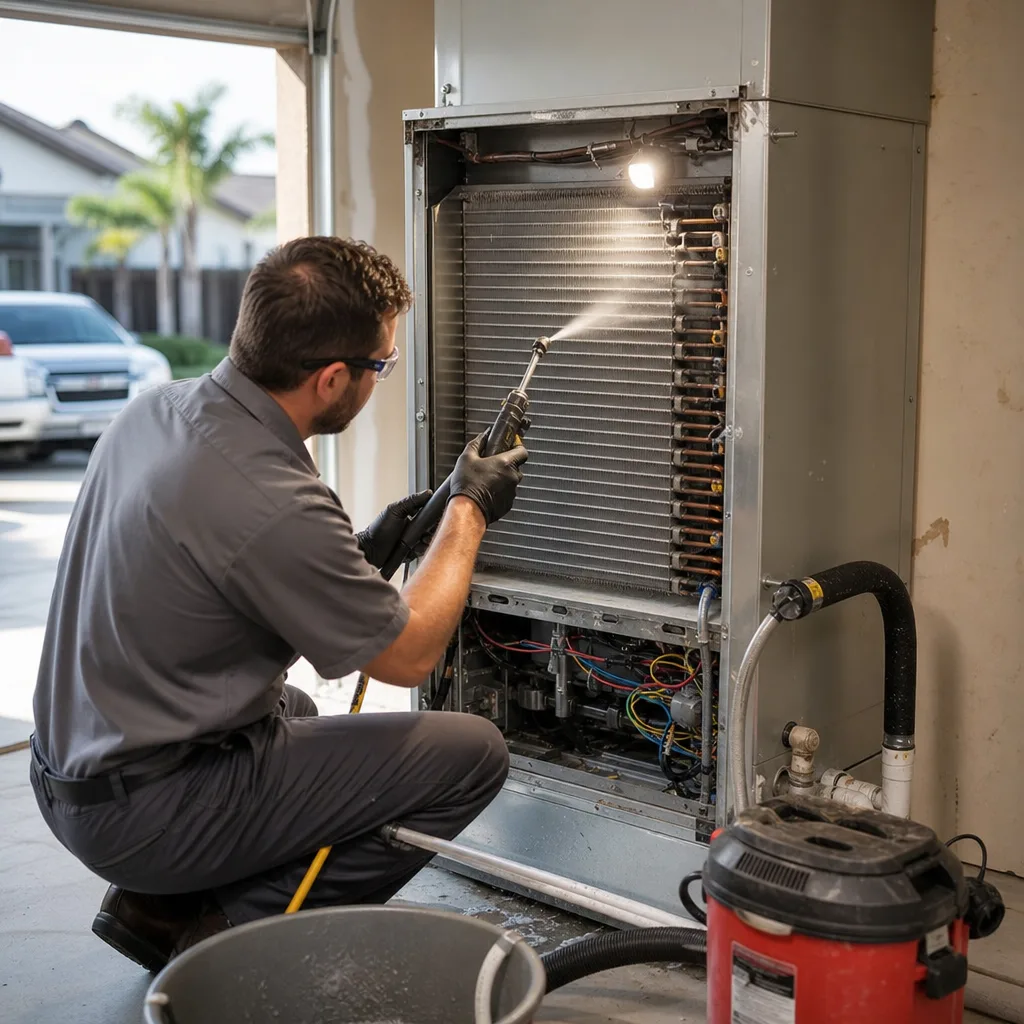
Simply vacuuming the inside of your ducts may not be sufficient to restore an HVAC system. Debris often collects on the mechanical parts that actually heat, cool, and move the air throughout your property.
The Importance of Evaporator Coil and HVAC Blower Maintenance
If you want to improve system efficiency and ensure proper airflow, several interconnected components must be addressed:
- Registers and Grilles: These are the entry and exit points for your indoor air. Over time, they collect sticky residues that trap dust.
- Evaporator Coils: These coils cool the air. When they get coated in dust, they act as an insulating blanket, forcing your system to work harder to cool your home or business.
- Blower Motors and Fans: Dirt on the fan blades reduces the system’s capacity to push air, putting physical strain on the motor.
- Sanitization: If there is a musty smell coming from your vents, a targeted sanitizing treatment can help eliminate the source of the odor.
Dryer Vent Cleaning: A Critical Fire Safety Step for Homes
For homeowners in Woodland Hills and nearby areas like Encino or Calabasas, dryer vent cleaning is a major safety concern. While air duct cleaning is often optional, cleaning a clogged dryer vent is essential for preventing fires, a safety measure that Premier Air Duct Solutions Woodland Hills strongly emphasizes to homeowners. Over time, highly flammable lint bypasses the dryer’s lint trap and builds up inside the exhaust duct, restricting airflow and causing the dryer to overheat.
According to an EPA research agenda document, the average residential duct cleaning job historically cost between $200 and $500. Adding a dryer vent service is a cost-effective way to protect your home from fire hazards while improving your appliance’s drying speed.[2]
What Does Commercial Vs Residential Duct Cleaning Cost?
Need commercial vs residential duct cleaning?
We’re available now — call for a fast, free estimate.
Understanding the pricing differences between these two services helps you plan your maintenance budget and avoid common contractor scams.
Typical Pricing Ranges for Professional Services
For a standard single-family home, you can expect to pay within the EPA-documented historical average range of $200 to $500, though larger homes with multiple systems can run higher. Most reputable residential companies charge either a flat rate per system or a base fee plus a set price per vent.
When it comes to effectiveness, cleaning methods matter. The National Research Council Canada notes that duct cleaning efficiency for dust reduction using compressed air and mechanical brush methods can range from 50% to 99% in scientific literature. However, a study by Florida International University showed that standard residential air sweep methods had only modest short-term effectiveness for tiny 1-micron particles. This highlights why high-quality, professional-grade equipment and meticulous workmanship are necessary to get real results.[1]
Why Commercial Projects Require Custom Estimates
You cannot easily apply a flat-rate pricing model to a commercial building. Commercial bids are calculated based on square footage, the number of air handling units, accessibility of the ductwork, and whether the work must be done after hours to avoid disrupting business operations.
To get an accurate price, a commercial manager can request an on-site walkthrough. Beware of any company that offers a low, flat rate over the phone for a commercial property, as this can lead to sudden price hikes or sub-par work once the technicians arrive. Premier Air Duct Solutions Woodland Hills provides upfront, transparent estimates with no hidden fees, ensuring local business owners know exactly what to expect.
Frequently Asked Questions About Commercial and Residential HVAC Cleaning
Navigating the maintenance of your heating and cooling systems can be confusing. Here are direct, straightforward answers to the most common questions we hear from local property owners.
What is the difference between commercial and residential duct cleaning?
The main differences lie in the scale of the system, layout complexity, equipment, and logistics. Residential systems are typically smaller, while commercial systems are larger, multi-zoned, and often integrated with complex building management controls.
Do commercial and residential duct cleaning use the same equipment?
No. Residential cleaning uses portable, maneuverable HEPA vacuums. Commercial cleaning requires heavy-duty negative air machines, pneumatic whips, and sometimes robotic cameras to clean deep inside metal duct networks.
How often should commercial air ducts be cleaned compared to residential?
Residential homes typically do not require routine duct cleaning unless there is a specific issue, such as remodeling dust, mold, or pest infestation. Commercial buildings, depending on the facility type and local guidelines, may establish periodic cleaning schedules to maintain their systems.
Why does commercial duct cleaning cost more than residential?
Commercial cleaning requires more labor, specialized machinery, custom access point creation, and detailed containment setups to prevent dust from spreading into active workspaces. These jobs are also frequently scheduled at night or on weekends to minimize business disruption.
What are the industry standards (NADCA) for commercial HVAC cleaning?
The National Air Duct Cleaners Association (NADCA) publishes guidelines for both residential and commercial cleaning. For commercial properties, these guidelines outline procedures for pre-clean assessments, containment, and cleanliness verification to help evaluate system cleanliness.
Can a residential duct cleaning company handle a commercial building?
Commercial projects often require different equipment, containment strategies, and technical approaches than typical residential jobs. A provider should have the appropriate machinery and familiarity with commercial system layouts to handle these larger networks effectively.
Need commercial vs residential duct cleaning?
We’re available now — call for a fast, free estimate.
Sources
- Effectiveness of duct cleaning methods on newly installed … – pubmed.ncbi.nlm.nih.gov (2003)
- Should You Have the Air Ducts in Your Home Cleaned? | US EPA – epa.gov
- Duct Cleaning Services Market Research Report 2034 – marketintelo.com (2034)
- Air Duct Cleaning Service Market Research Report 2034 – dataintelo.com (2034)
- Air Duct Cleaning Service Market Size, Future Growth and Forecast … – strategicrevenueinsights.com (2033)
Related reading: Aeroseal Vs Manual Duct Sealing – 10% Off & Free Estimate – Same-Day Service
Related reading: Air Duct Repair Services Woodland Hills | Call Now-10% Off | On-Site in 60 Minutes | Free Estimate
Related reading: Air Duct Cleaning Woodland Hills CA – Breathe Cleaner Air Today
Frequently Asked Questions
How should a business prepare its facility before a commercial duct cleaning team arrives?
To minimize operational downtime, businesses should clear pathways around main HVAC registers, secure sensitive paperwork, and coordinate with the technicians to schedule zoned cleanings. Premier Air Duct Solutions Woodland Hills works closely with commercial managers during a pre-service walkthrough to establish a seamless, non-disruptive workflow. Contact Premier Air Duct Solutions Woodland Hills for a free, no-obligation estimate and professional consultation to plan your facility's service.
Can residential duct cleaning completely eliminate persistent pet odors and mold from a home?
While vacuuming removes physical debris, completely eliminating persistent biological odors and mold spores requires targeted sanitization treatments applied directly to the ductwork and coils. Premier Air Duct Solutions Woodland Hills utilizes specialized, EPA-approved sanitizers to neutralize these stubborn contaminants safely. Homeowners can contact Premier Air Duct Solutions Woodland Hills for a free, no-obligation estimate and professional consultation to address specific indoor air quality concerns.
How can I verify if a contractor is truly qualified to handle both commercial and residential HVAC systems?
Property owners should look for providers with active NADCA certifications, specialized commercial and residential divisions, and a proven track record of handling complex layouts. Premier Air Duct Solutions Woodland Hills maintains dedicated teams equipped with both portable HEPA units for homes and industrial negative air machines for businesses. Contact Premier Air Duct Solutions Woodland Hills for a free, no-obligation estimate and professional consultation to discuss your system's specific requirements.
About the author
 |
Sarah Jenkins Sarah Jenkins is a certified indoor air quality specialist and content writer with over seven years of experience in the HVAC industry. She holds a B.S. in Environmental Science from California State University, Northridge, giving her a strong foundation in understanding residential and commercial air systems. Sarah is passionate about educating Woodland Hills property owners on the importance of professional duct care for creating healthier, more efficient spaces. |
Dusty vents or weak airflow at home?
We’re available now — call for a fast, free estimate.
Get Started