
Quick Summary
Indoor air quality testing in Woodland Hills evaluates how summer heatwaves and compromised building envelopes trap fine dust, fiberglass particles, and outdoor pollutants inside homes. Diagnostic testing from Premier Air Duct Solutions Woodland Hills identifies specific contaminants like mold spores and VOCs while uncovering root causes in attic ductwork and ventilation systems. Readers will learn what a comprehensive air inspection entails and how targeted HVAC remediation effectively restores clean, safe indoor air.
Indoor Air Quality Testing in Woodland Hills
Indoor air quality testing evaluates residential and commercial properties for airborne particulate matter, chemical vapors, mold spores, and ventilation performance. High summer temperatures can place stress on residential building envelopes. When homes are tightly sealed against the heat, airborne irritants can become trapped indoors. A 2007 field study by the California Air Resources Board found that half of the tested single-family homes had outdoor air exchange rates below 0.35 air changes per hour, demonstrating how indoor contaminants can build up without proper mechanical ventilation.[1]
For property owners, poor indoor air is rarely just standard room dust. Attic heat and pressure shifts can pull attic insulation particles, fine dust, and outdoor smoke into the living space. Professional diagnostic testing from specialists like Premier Air Duct Solutions Woodland Hills identifies the pollutants in your air and helps determine whether the root cause lies in your building envelope, duct system, or indoor sources.
What Does an Indoor Air Quality Assessment Include?
A professional air quality inspection measures physical and chemical contaminants to evaluate the safety and comfort of your living space. Technicians use calibrated particle counters, photoionization detectors, and air sampling pumps to capture real-time data throughout the home.
- Particulate Matter (PM2.5 and PM10): Measures microscopic dust, soot, wildfire smoke, and loose fiberglass insulation fibers suspended in the air.
- Volatile Organic Compounds (VOCs): Scans for chemical off-gassing from building materials, paints, cleaning solvents, and synthetic furnishings.
- Mold Spores and Biological Contaminants: Air and surface samples identify active fungal colonies, high spore concentrations, and hidden moisture issues.
- Ventilation and Air Exchange Rates: Evaluates whether the HVAC system brings in adequate fresh outdoor air or traps stale air inside.
- Carbon Monoxide and Combustion Byproducts: Checks gas furnaces, water heaters, and attached garages for dangerous backdrafting.
How Much Does Indoor Air Quality Testing Cost?
Local costs for indoor air quality testing vary depending on the size of the building, the number of HVAC zones, and the depth of laboratory analysis required. No authoritative Woodland Hills specific price was identified.[4]
Why Heatwaves and Attic Infiltration Degrade Indoor Air
Need indoor air quality testing in Woodland Hills?
We’re available now — call for a fast, free estimate.
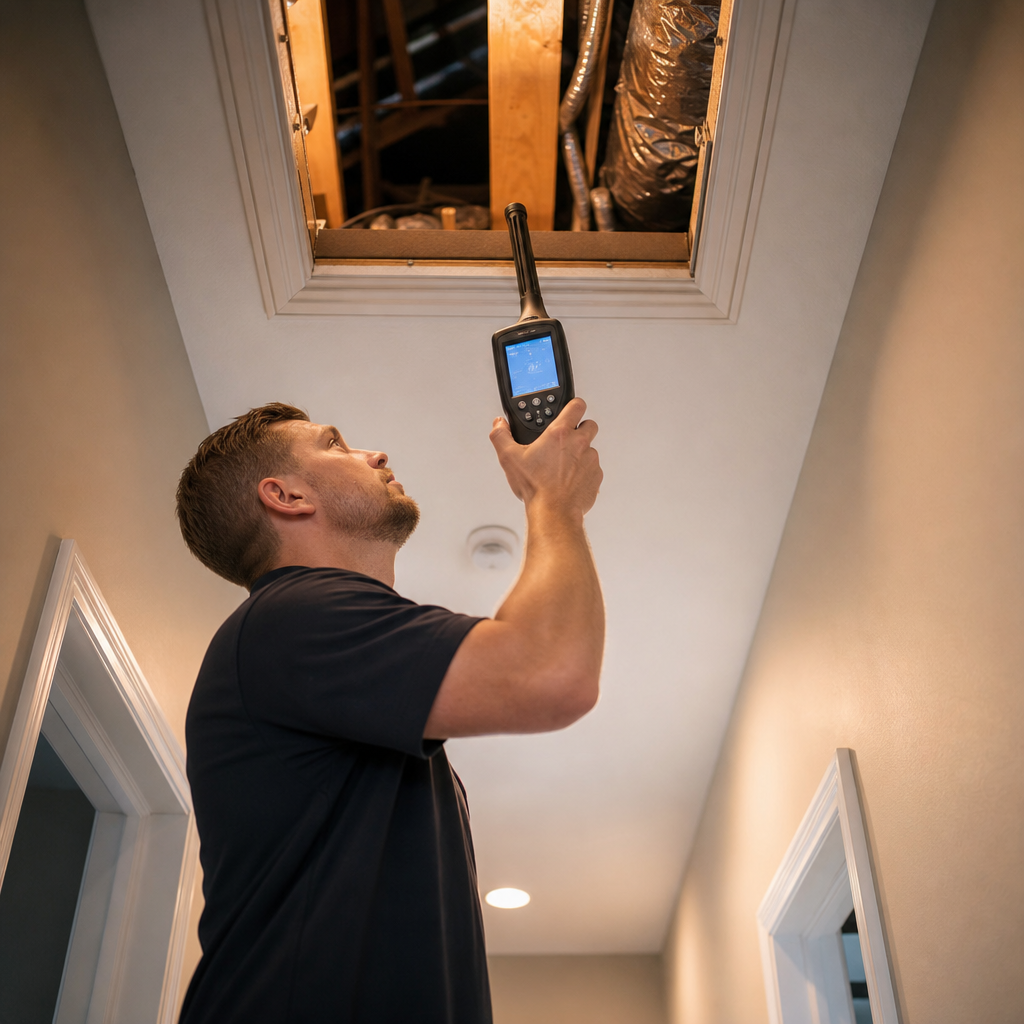
During summer heatwaves, unconditioned attic temperatures can rise substantially. This thermal stress can accelerate the wear of flexible duct jackets, mastic sealants, and adhesive tapes.
When the air conditioning blower operates, return air ducts run under negative pressure. If attic heat has contributed to micro-fractures along duct seams or loosened plenum connections, that negative pressure can draw attic air, fiberglass insulation dust, and settled debris directly into the ductwork. The HVAC system can then distribute these particulates into living areas.[5]
Wind events can also push outdoor fine dust and particulates through attic vents, increasing dust in the attic cavity. If duct connections have minor leaks, those particulates can enter the indoor air supply.
A California field study conducted by Lawrence Berkeley National Laboratory found that mechanically ventilated homes were up to six times tighter than older, non-mechanically ventilated homes (median 1.1 vs. 6.1 ACH50). In tightly constructed homes, once contaminants or VOCs enter the living space, they remain trapped without dedicated mechanical ventilation.[2]
Which HVAC Components Most Affect Air Quality Test Results?
When an air quality test detects elevated particulates or mold spores, teams such as Premier Air Duct Solutions Woodland Hills note that the underlying cause is frequently found inside the forced-air system itself. Diagnostic testing helps identify which mechanical components need attention.
| System Finding | Probable Root Cause | Recommended Corrective Action |
|---|---|---|
| High airborne fiberglass and fine dust | Micro-tears in flex ducts; degraded mastic tape in attic | Duct repair, mechanical joint sealing, and outer jacket re-wrapping |
| Elevated mold spore counts (Cladosporium, Aspergillus) | Standing moisture in AC drain pan; dirty evaporator coil fins | Coil cleaning, drain line clearing, and condensate treatment |
| Chemical odors, elevated VOCs, or burning smells | Severely restricted dryer vent line forcing exhaust back into walls | Complete dryer exhaust cleaning and exterior hood inspection |
| High fine particulate matter (PM2.5) across all rooms | Low-efficiency or ill-fitting HVAC filters letting bypass air circulate | Filter rack adjustment and upgrading to properly rated MERV filters |
Frequently Asked Questions
What do professionals check during an indoor air quality test?
Inspectors check airborne particulate levels (PM2.5 and PM10), volatile organic compounds (VOCs), carbon monoxide, relative humidity, and temperature. Depending on your concerns, technicians from Premier Air Duct Solutions Woodland Hills also collect air and surface samples for laboratory mold spore analysis and inspect ductwork for leaks and debris accumulation.
How do I know if my home needs air quality testing?
You should consider scheduling an assessment if you notice unexplained allergy or asthma flare-ups at home, persistent musty or chemical odors, excessive dust accumulation shortly after cleaning, or uneven cooling. Testing is also recommended after water leaks, major remodeling, or nearby wildfire events.
Does air duct cleaning improve indoor air quality test results?
According to guidance from the US Environmental Protection Agency (EPA), duct cleaning is only recommended for specific contamination problems (such as substantial visible mold growth, vermin infestation, or severe clogging with dust and debris) and is not recommended as a routine air quality fix.
How long does an indoor air quality assessment take?
A typical on-site inspection for a single-family home takes between 1 and 2 hours. The technician records real-time sensor data, inspects the air handler and attic ductwork, and collects any necessary air samples. Real-time readings are available immediately, while formal laboratory results are usually delivered within several business days.
What are the most common indoor air pollutants in California homes?
Common indoor pollutants include fine dust, fiberglass particles, pollen, mold spores, and outdoor smoke particulates (PM2.5). California studies have examined ventilation, formaldehyde, nitrogen dioxide, and PM2.5 to evaluate indoor air quality across residential properties.[3]
Need indoor air quality testing in Woodland Hills?
We’re available now — call for a fast, free estimate.
Sources
- Sustainable Energy & Environmental Systems Department – eta-publications.lbl.gov (2007)
- Indoor Air Quality Research – California Air Resources Board – ww2.arb.ca.gov (2018)
- Ventilation and Air Quality in New California Homes with Gas … – energy.ca.gov (2020)
- Progresses and Challenges on Indoor Air Quality in California – ww2.arb.ca.gov (2005)
- IAQ in Mechanically Ventilated U.S. Homes – eta-publications.lbl.gov
Frequently Asked Questions
How do Santa Ana winds impact indoor air quality testing in Woodland Hills?
High-velocity wind events force fine outdoor dust, ash, and seasonal pollen directly into unconditioned attic spaces. If your return ducts have micro-tears or loose connections, the HVAC system pulls these particles into the living areas, causing sharp spikes during particulate testing. Premier Air Duct Solutions Woodland Hills evaluates both ambient air levels and attic duct integrity to prevent wind-driven contamination.
What happens if an indoor air quality assessment detects elevated mold or fiberglass particles?
When testing reveals elevated contaminants, diagnostic tools trace the issue to specific mechanical faults, such as standing moisture in evaporator coils or degraded mastic tape on attic flex ducts. Premier Air Duct Solutions Woodland Hills provides targeted remediation, including duct sealing and coil treatments, with a free upfront estimate to restore healthy indoor airflow.
How should I prepare my home before a professional indoor air quality test?
Keep all windows and exterior doors closed for at least 12 to 24 hours beforehand to establish a representative baseline of your home's air exchange. Avoid burning candles, using harsh aerosol cleaning products, or running portable air purifiers immediately before your appointment with Premier Air Duct Solutions Woodland Hills so the diagnostic equipment captures accurate readings.
About the author
 |
Marcus Reid Marcus is a certified HVAC technician with over 12 years of experience in residential and commercial air quality systems. He specializes in providing actionable advice on air duct maintenance and dryer vent safety for property owners in Southern California. Marcus focuses on practical solutions that improve indoor air quality and system efficiency. |
Dusty vents or weak airflow at home?
We’re available now — call for a fast, free estimate.
Get Started